Send Light, Room III

The Prayers of the Saints

Instrumentation: MacBook, headphones, microphone, generative 2-channel sound, and recorded contributions from visitors

Duration: Indefinite

Program Note:

Send Light, Room III is an interactive and generative audio installation composed using Max. I created this work as a sequel to Send Light, Room I and Send Light, Room II.

Like Room I, the work consists of gestures constructed out of recordings of a marimba and a vibraphone which transpose every 25 minutes and are randomized so as never to repeat. Unlike Room I, visitors to the installation listen over headphones, entering into the intimate and secluded bubble of the work’s soundscape in an otherwise noisy space. The visitor is then prompted (if they so desire) to leave a message of blessing or encouragement for subsequent visitors to the installation using the provided microphone and on-screen instructions for recording.

The work was primarily intended as an expression of solidarity among Queer people of faith who are often excluded from their religious communities and was partly inspired by the work the Polish artist Daniel Rycharski who explores his intersecting Queer and Catholic identities in his work. Send Light, Room III intends to offer Queer people of faith an occasion in which to give and receive encouragement, support, and the “words that they needed” in prior seasons of life.

Send Light, Room III was first installed during the Summer of 2025.
Folk Computer: DMA Recital Installation

Instrumentation: Folk Computer installation, stereo electronics, projector, macbook

Duration: Indefinite

For my DMA Recital, 𝘗𝘢𝘱𝘦𝘳 • 𝘈𝘪𝘳 • 𝘓𝘪𝘨𝘩𝘵 (March 18 at the Dancz Center for New Music blackbox theatre), I set up an interactive Folk Computer installation in the hallway outside the blackbox. It served both as a Brian Eno-style generative/ambient audio installation as well as an interactive exhibit for passersby and those waiting to enter the hall.

The installation was a supplement to the traditional paper/digital recital program, with the Folk Computer platform enabling me to create projection-mapped QR codes which served as a means of navigating a digital exhibit concerning the various pieces on the program. (This concept of a broader exhibit surrounding a musical concert or event falls into the category of “hypermusic” coined by Paulo de Assis).

By interacting with the QR codes on the table, visitors could learn more about each piece on the program in addition to triggering reactive audio cues that contribute to the generative soundscape.

The Folk Computer installation handled the table-top projection mapping and registered the presence/occlusion of the QR code programs on the table. These programs, in turn, directed Folk to project custom graphics onto the table and to send OSC messages to a Max patch running on a macbook in the ceiling space of the hallway. This macbook drove the wall-facing projector graphics and the audio running to the two nearfield monitors.

Send Light, Room II

Descent

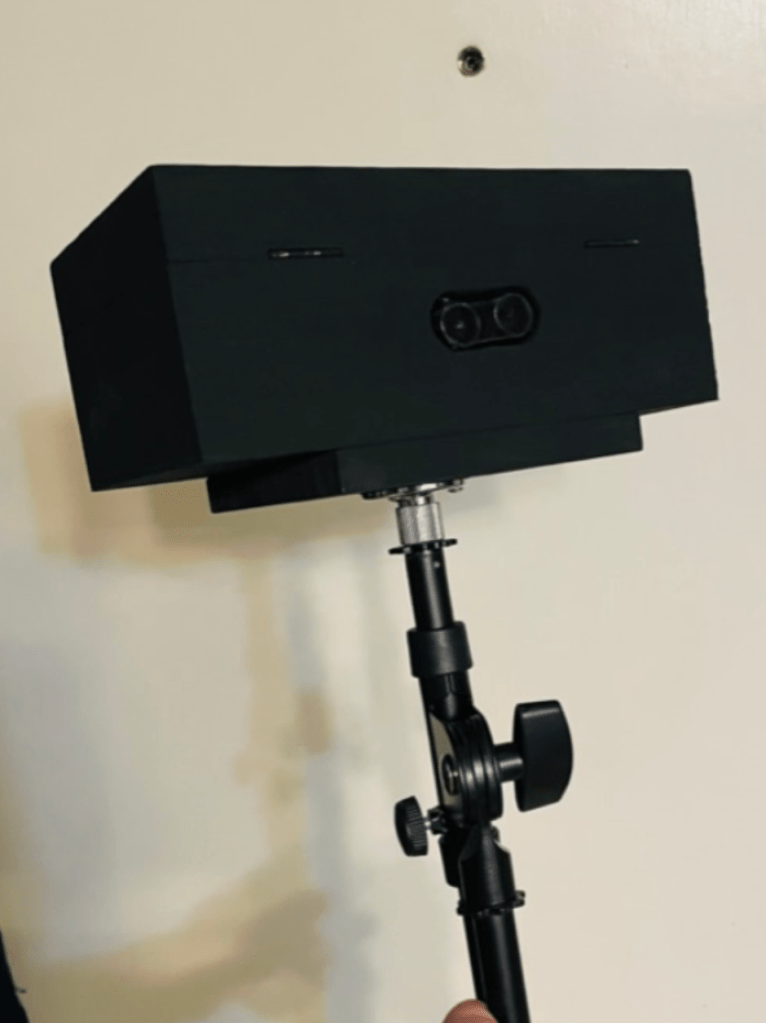
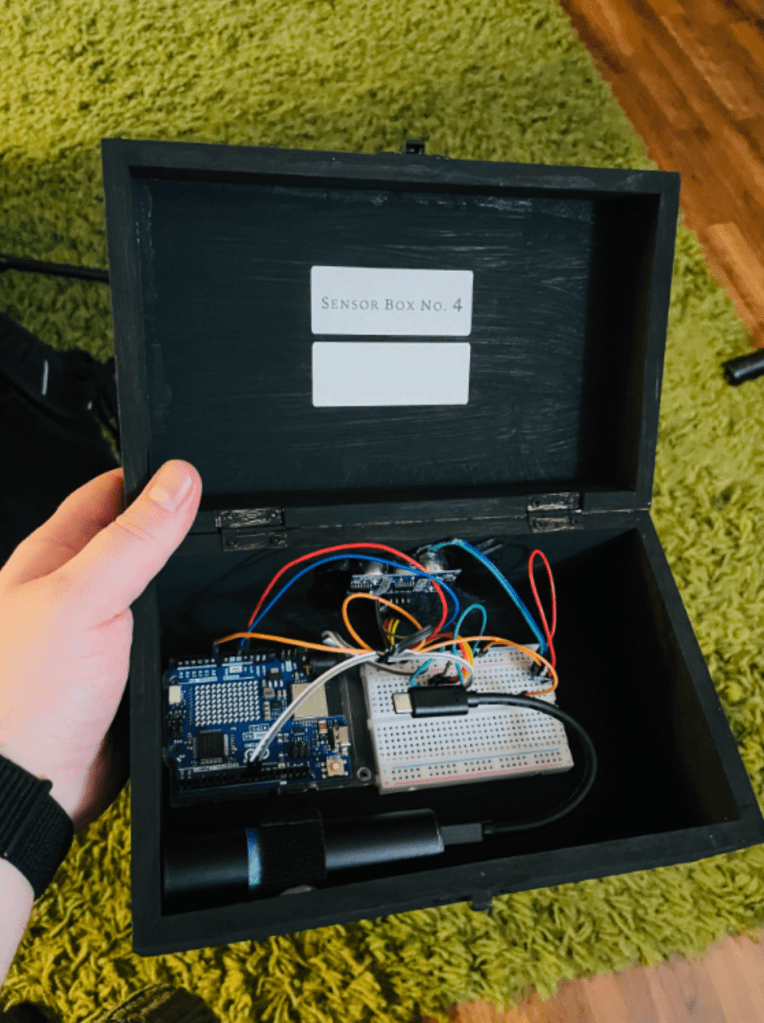
Instrumentation: Interactive/generative 8-channel electronics – MacBook, iPhone, metallic resonator, 4 arduino sensor boxes, DMX lighting

Duration: Indefinite (installation), 8-20 minutes (performance)

Program Note:

Send Light, Room II is an interactive and generative audio-visual installation/performance piece composed using Max. I created this work as a sequel to Send Light, Room I after reading Mark Z. Danielewski’s experimental horror novel House of Leaves. The work gradually developed between Fall of 2024 and Spring of 2026, with each iteration adding more capabilities and refinements to the installation/performance.

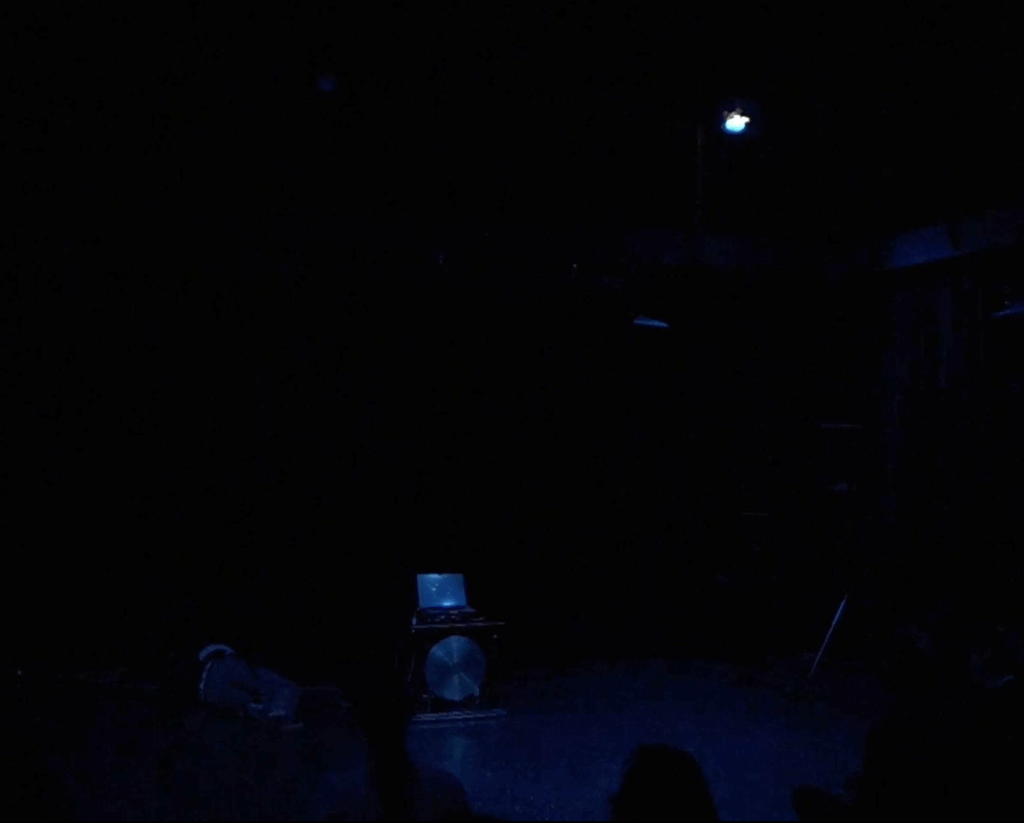
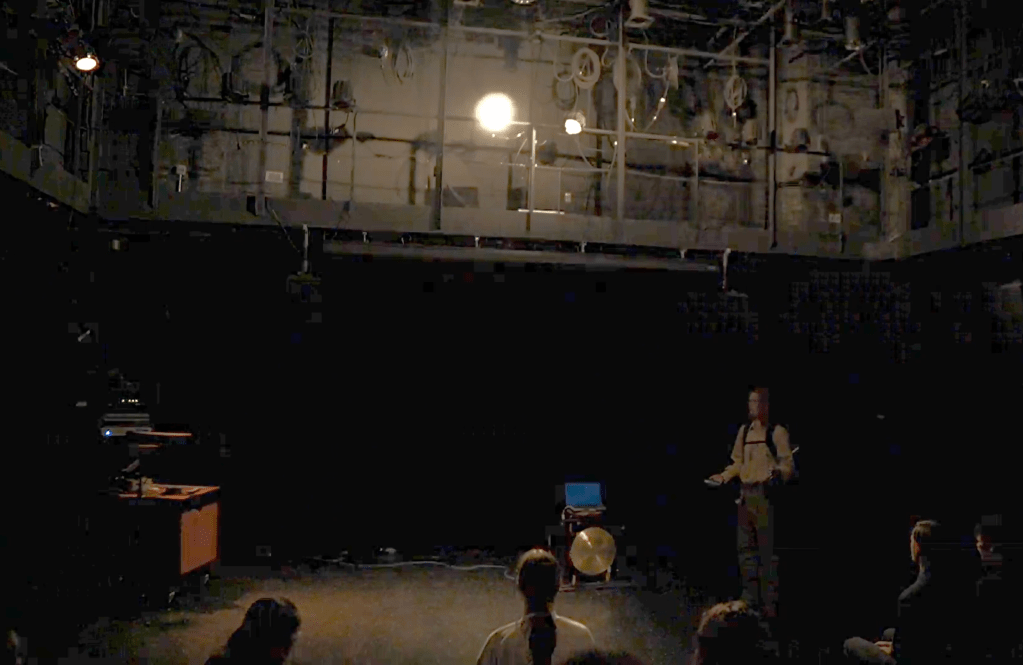
The visitor or performer interactively explores the work by roaming around the installation space in darkness, holding the iPhone and a flash light (which they may or may not elect to use). They are able to enact various gestural commands on the iPhone, with the Max patch constantly receiving streams of OSC data – one measuring the proximity of the iphone to the centrally-placed laptop, four measuring the proximity of the performer to various arduino sensor boxes, and four measuring the amount of light each arduino sensor box receives.

These interactions cue recitations of texts that meditate on the themes of House of Leaves – grief, loss, the experience of constructed spaces, resonance, love, labyrinths, madness, ecstatic experience, and the divine. The readings are then surrounded and punctuated by the ghostly howling of a perpetual wind, the metallic humming of a disembodied minotaur at the center of the installation’s “labyrinth,” and the angry red flickering of an unknown and dangerous light from the laptop.

The interactions of the visitor/performer with the sensor boxes occasionally cue angry “thunderstorms” in the installation, rapidly sending DMX commands to the lighting system. After enough of these storms have accumulated, the installation begins its ending sequence which dramatizes the climax of Danielewski’s House of Leaves.

Send Light, Room II represents my most involved technological experiments to date – it was a wonderful challenge to incorporate Arduino microcontrollers and DMX lighting control into my work for the first time in live performance.

The work is intended to be experienced in a large, multi-level space in close to absolute darkness.

Premiere:  March 18, 2026; Athens, GA. William Emde, performer.

Send Light, Room I

A Space for Comfort, Prayer, and Contemplation

Instrumentation: Generative 4-channel sound and accompanying real-time visualization

Duration: Indefinite

Program Note:

Send Light, Room I is a generative audio-visual work of indefinite length composed using Pure Data. I created this work during a time of crisis when I wanted to be able to share something like a “quilt or blanket of sound” with a loved one across geographic distances.

The work consists of gestures constructed out of recordings of a marimba and a vibraphone which transpose every 25 minutes and are randomized so as never to repeat. Over this sonic background is suspended a series of 40-odd readings by the composer of poems and prayers, with the readings progressing every 8 minutes.

The work is intended to be heard via a quadrophonic speaker array, enveloping the listener in a wash of bright, resonant sounds coming from every direction. It may also be experienced more intimately via headphones. The optimal space for listening is a room with dim, warm lighting or a space illuminated by candlelight.