
When I started composing, I was keenly aware of the importance of form. As a middle school pianist writing my first pieces, I knew the basics of binary, ternary, sonata, and rondo form and spent quite a bit of time ensuring that I could actually compose a movement in sonata-allegro form. While I rarely if ever think in terms of classical forms now while writing, I found this experience in working within traditional forms to be invaluable. As I started my undergraduate studies, I had opportunity to learn some alternative approaches to constructing time, but my compositional approach remained quite focused on pitch and thematic materials in creating a formal structure for my pieces. My thinking was centered on local events and of the progression from one brief theme or idea to the next. Some of my eventual interest in pushing beyond the “molds” of traditional form can be seen in the schematic below outlining tonal areas for my Sonatine for Flute and Piano. (I was very taken with Richard Cohn’s Audacious Euphony at the time and wanted to explore all the third relation

A formal schematic of my Sonatine for Flute and Piano.
The three movements are indicated by roman numerals on the left.
When I began my graduate studies, I was very fortunate to study with some composers who continued pushing me to explore other approaches to form. They taught me a helpful technique for constructing pieces from the top down, rather than exclusively from the bottom up. In this approach, the composer begins by attempting to capture as much of the general outline of the piece as is possible, imagining the work through audiation in several subsequent “passes” through the work which gradually bring the piece “into focus.” I might begin with identifying the main “events” of the piece on a timeline before taking another pass to imagine the transitions, the orchestration or tessitura, etc. In this practice, energy and gesture are highlighted first, with local rhythms and pitch material only being resolved after several passes through the material.
This is the approach that I have most commonly used in writing the last several of my works, but I think a healthy compositional practice involves alternating between techniques as is needed, now looking at the overarching scope of the work, now looking at the individual materials and what they want – how they may come to shape the energy of the work.
Along the way, I’ve developed some tricks and techniques for engaging this practice. I’ll outline a few of the things that have been particularly helpful for me.
Analog Tools
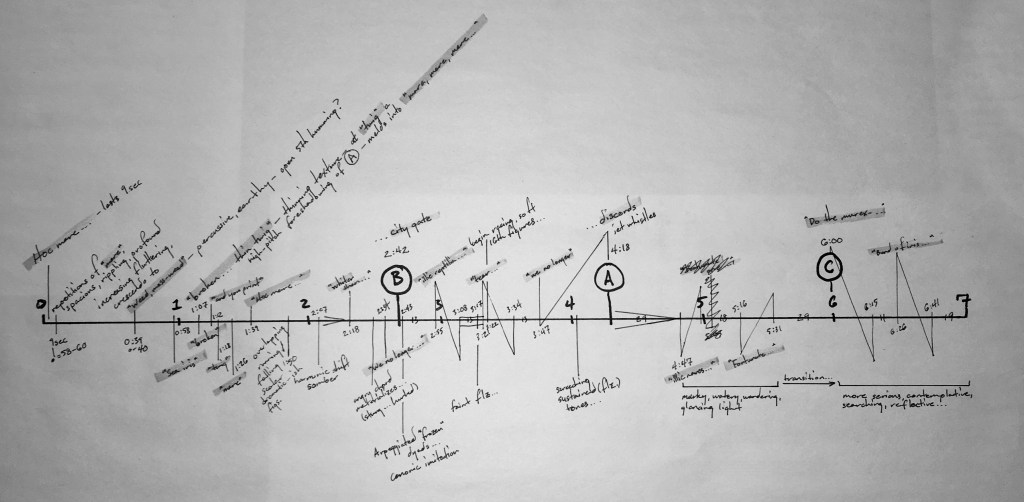
Early on in my graduate studies I went to the local art supply store and bought some large pads of newsprint paper. It’s rather thin, grainy material, but it provides a low-cost way to work out ideas on a large canvas. My 18-inch ruler accompanies my newsprint pads and together with some sharpies, these tools are indispensable for quickly plotting out the form of a work. (Highlighters and smaller multi-colored pens are also a great addition to this toolkit). Here’s a sample event timeline for my piece, Quiver and Quench
Form in OpenMusic
Alongside these analog tools, I’ve also found it extremely helpful to do some work in a custom OpenMusic patch that I made a few years back. Here’s a quick look:

At its creation, I named this patch form-to-golden-section-bpf (breakpoint function) because it does pretty much what one might think. In this case, I’ve supplied the patch with the duration of Quiver and Quench – 7 minutes – and have let the patch calculate some potential timings for important events over the course of the piece. (As an aside, I don’t hold the view that there is actual empirical merit to the idea that the golden section forms musically-effective proportions, but I find that I need to subdivide my music somehow and I might as well pick a convenient proportion – anything that will provide a place to “hang my hat” as I’m working through the form of the piece).
In the case of this patch, I ask OpenMusic to partition the movement divisions (in this case 0 mins – 7 mins for a single-movement piece) according to the golden section, producing a timing for an important event at about 4:18. I then have OpenMusic subdivide these new proportions (4.3 mins and 2.7 mins) according to the golden section again, producing timings for events that I might consider slightly less important at about 2:42 and 6:00.
While these calculations can easily be carried out by hand with some simple math, I’ve found it very helpful to have this patch handy so that I can instantly calculate timings for events in proportion, especially when I’m still testing out the duration of the work. In some cases, I’ve had “event lists” from the timeline for a piece with something like 20 or 30 events. It’s very convenient to be able to pipe them through a patch, adjust the total duration, and see all of the events recalculated to stay in proportion.
Finally, it’s also incredibly helpful to see these events and proportions plotted on a BPF. I can look at a glance and understand how close together or far apart these events will be, noticing if any events, movement divisions, or golden section proportions coincide.
TimeScrub
As I work with OpenMusic and my newsprint-paper/sharpie timelines, I also make frequent use of a little patch that I put together in Max to help facilitate the process of audiation. This came from a need to scratch the itch for a fairly lightweight program that would simply provide me with a scrubber/slider interface that didn’t actually do anything. I wanted a little app that would work as a visual timing aid and that could:
- show the total duration of the piece, displaying where in “real time” I am as I engage audiation,
- respond to some specific keyboard hotkeys to quickly play, pause, jump forward or back,
- “bookmark” specific moments where I could imagine the piece moving in a different direction using a convenient hotkey,
- avoid using a lot of computer power and battery. (I’m still working on this one!)
I could, of course, have used software like Logic, Audacity, or even VLC player and just created an empty project or silent audio file, but I wanted something that would be relatively more lightweight and that wouldn’t get in the way of the creative process while I’m in the middle of imagining a piece.
I settled on calling this little app TimeScrub; a preview is shown below:
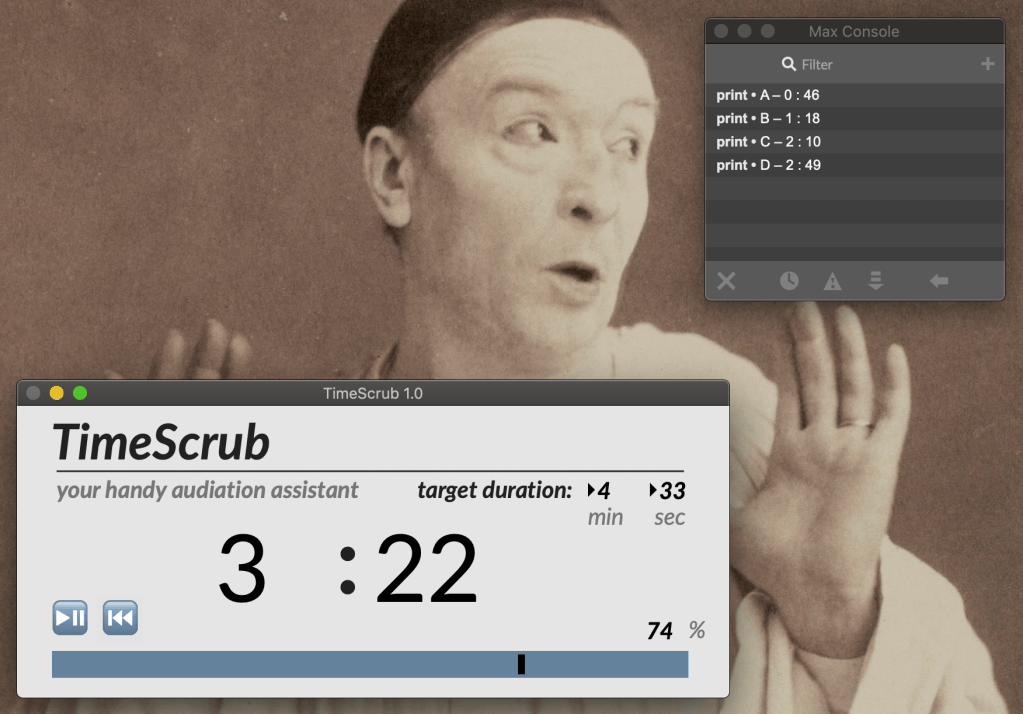
The TimeScrub display window and Max Console showing
incremental time events that have been “bookmarked”
The main virtue has been how easy it is to navigate with TimeScrub and how quickly I can move from one moment or task to the next. As I capture the first written draft of a piece on manuscript paper, I can easily switch back and forth between pausing to capture important details of notation “out-of-time” and returning to the internal flow of time within the piece, keeping my metronome handy and marking timing indications above measures in the score so that I know exactly where the materials fall within the unfolding landscape of the form. If I don’t particularly feel like starting from the beginning of the piece, I can find a spot on my sharpie/newsprint event timeline and dive in at the appropriate point in the piece.
It feels a little silly to mention something so seemingly inconsequential, but TimeScrub has been a very efficient tool to let me dive into “audiation mode” as I’m hammering out the form for a piece. I don’t have to fire up Logic or Audacity or pull out a stopwatch. TimeScrub cuts out distractions and and helps me focus on what I’m trying to hear and imagine.
Final Thoughts
Together, these various tools have been a huge aid to my compositional process, enabling me to work quickly and freely, imagining a “temporal scaffolding” for a new piece without having to bother with lots of work plotting out durations, working in Max or OM patches, or just feeling “lost” in the form. In the future, I’m sure there will be other approaches that I wish to experiment with. For one, I’ve been fascinated with the projects that folks in the new music community have produced that use tempo curves. In these works, the piece appears to be conventionally notated but is facilitated in performance by click tracks or other software to guide the performers through independent and continuously-varying tempi. The tools and techniques developed around composing and performing such works offer an even further degree of expressive flexibility in organizing time on an independent and continuous performer-by-performer basis.
I’d love to hear how you think about form! If there’s an approach you think I should know about or research that you’re doing on the topic, I’d be delighted to learn more.

